Showing posts with label Talk Nerdy to Me. Show all posts

Friday, April 24, 2015

Happy Birthday Hubble!


I just wanted to give a birthday shout out to the Hubble Space Telescope. Today marks it's 25th anniversary! Thanks to this telescope that was launched on April 24, 1990 we've been able to capture amazing images from our solar system and learn a lot more about the universe.  These photos are a few of my favorites.

Hubble's Greatest Hits- in my opinion

Some fun facts about Hubble:
  • It transmits 120 gigabytes of data weekly- WOW!!!
  • There has been  4 service missions since it's launch 
  • It is  travelling about 17,500 mph
  • It takes only about 97 min to orbit Earth 
  • Hubble is about the size of a school bus
  • It's solar powered
  • It's named after astronomer Edwin Powell Hubble whos was nicked named the "pioneer of distant stars"  
You can find out more about of Hubble's amazing achievements at these links:

Hubble Space Telescope from NASA

Hubble's Discoveries from hubblesite.org

50 Best Hubble Images from Time Magazine

If you are looking to do something locally the Great Lakes Science Center is showing the Hubble movie in Imax daily at 2pm through the Sunday. I really like the movie still and that says a lot after I've seen probably over 20 times while working there. It follows the astronauts on one of the repair mission of Hubble. Trailer is below


Sunday, April 19, 2015

Dark Skies


It seems like lately every day/week/month has some obscure celebration connected to it. It makes it very hard to keep up and I almost slipped noticing that this weekend wraps up the end of International Dark Skies Week!

Never heard of it? Well it celebrates one of my favorite things: star viewing and also fights to limit light pollution.  It's amazing how much light we emit into the night sky. It's not just places like Times Square or Vegas that blocks star viewing it's also coming from your own yard and street.  Some might say so what if you can't see big burning balls of gas trillions of miles away but light pollution also is threatening the future of some nocturnal species. Some easy things you can do to help is installing lighting fixtures that reduce skyward light emissions. 
such a difference lights make
 I'll never forget camping with my 6th graders in a ridge of the Appalachian mountains and being able to actually see the Milky Way! Most of the students living in the city had never really seen any stars. We were all in awe of how gorgeous the night sky was. It was amazing to be able to actually see the stars and planets in nature rather than having use my planetarium to show the constellations. 
Doesn't everyone have an inflatable planetarium?
Now in case you missed you missed celebrating International Dark Skies Week, fear not Clevelanders you are in luck. Did you know that just a short drive away is 1 of only 22 certified dark sky parks in the world?

Observatory Park is just about an hour east and is part of the Geauga county park system in Montville.  It's open daily 6AM-11PM with some programming throughout the week and extended hours during astronomical events. Its a green space with cute little walking trail of the solar system, telescope pads/electrical hook ups and special hooded red lights to help with night time viewing.

view of the buildings

 As you would expect since it is a sanctioned dark zone there is not much around the area. It's also a fairly small park, it's main purpose is for night viewing so there are limited picnic tables and trails.  Don't expect to find much in way of restaurants and night life in a 15 mile radius. Observatory park is conveniently located within a 20 minutes or so drive from a lot of  the wineries.

 W and I finally made the trek to the park after taking a wine trail tour. A win- win combination of daytime events.  We made it to park just near dusk with plans to stay for nighttime viewing but a massive thunderstorm cut our trip short. I will say the bathroom building was a great little place to wait out tornadic weather!

check out those angry clouds
 Every time I've attempted to make the journey to Observatory Park at night it's been cloudy or stormy weather. Kind of like this week the Lyrid meteor shower is peaking and it's expected to rain Ugh oh well I'm looking forward to the next time I can visit the park and until then I'll just have to enjoy the shows at local planetariums.


Sunday, March 2, 2014

Science behind...snowflakes

As I was driving in to school the snowflakes were perfectly landing on the window so I could see each one's unique shape. It was so cool to see all the different designs. It got me thinking that maybe it's time for a little science behind how snowflakes get their shape. It's a lot more complicated than you think! Actually it's pretty amazing that all these variables came together to form all that white stuff we've had this season.

How do snowflakes form? 
Snowflakes start out simply enough, they are just bits of water vapor in the air. High up in the atmosphere where is very cold that water vapor condenses into liquid and you'll get clouds. In snow forming clouds they are cooled below freezing point (about 14 F) and those liquid drops freeze. As time goes by more water vapor condenses on it's surface the snow flake grows. When it reaches a point that it's too heavy it will fall as precipitation. So that's the easy part..now depending on things like temperature, humidity, and atmospheric pressure will determine the shape and complexity.

 I could totally nerd out on you because there is a lot of math and molecular/structural engineering if you want to get down to the nitty-gritty of it but I won't and try to keep it simple. If you do want more of that kind information there is a ton of resources out there and  people are even obsessed with researching it so! Let me know and I'll point you in the direction. 


 When water turns to ice those molecules stack to create crystalline lattice (see previous post about ice). Ice has a hexagonal symmetry and this basic shape will determine the overall symmetry of the snowflake and why there is usually 6 arms to a snowflake. The growth of crystals is split between balance of facets and branches. Check out this 2 minute video to watch the stunning growth of snow crystals.

Facets are simple flat surfaces with sharp edges. This is from very slow growth of the crystal and gives you the prisms and plates. Branching makes the more complex structures we tend to think of as a snow flake.  Branches start as a small bump of growth that sticks out further on the crystal. Since that is what the vapor will come in contact with first more will grow off of that area quickly. As more grows the flake becomes more complex.  If snow crystals are formed below atmospheric pressure there will be less branches, higher pressure means more branches. As snowflake moves it is in differing temperatures and pressures so the growth of arms can be different that other flakes making it unique.

Temperature and humidity will also strongly influence the growth of snowflake between faceting and branching. This means that snow crystals can be very diverse. Have you ever heard that it's too cold to snow? Well really it's about the humidity usually when it is very cold it has already snowed and air is dry. There isn't more water vapor  to make new snow. So far this season I've seen the big fluffy flakes, the tiny diamond like grainy ones, wet sloppy, needles, unique branching, and and a white out all these are due to the climate.  

Are two snow flakes really alike? 
Since there are so many variables that go into play in creating a snowflake statistically it is highly unlikely that two complex snowflake structures are exactly alike... but really who is going to collect and check every snow flake that is ever fallen? Not it! To get a more in depth answer check out this page  There also is a wealth of more than you ever wanted to know about snowflakes at that site. 

What are some fun activities I can do about snow?
There are lots of cute activities that range from craft to science experiments on the internet. Here are just a few I like that can be adapted to any situation

1) snowflake scavenger hunt Printable PDF of the different shapes. Take it outside and see what you can find!

2) 15 great activities that are snow and ice related you can do at home or at school with kids from inspiration laboratories

3) This is one of the those cool kitchen chemistry "magic trick" experiments you can wow kids or adults called hot ice. 


4) Go back to basics and enjoy sledding or snowman building


With storm system after storm system I feel like I'm living out part of the Seven Brides for Seven Brothers movie: the June Bride Song sequence...sigh such a great movie. 

Don't worry the first day of spring is around the corner....well at least that's what the calendar says!


Here is one more really neat video from BBC about snowflakes sorry I think this is just too cool!

Monday, December 23, 2013

Science Behind....frozen water


ice..ice..baby duh duh dunt dunt duh source: NOAA
Winter is on us full force and there are always a few questions surrounding the topic of ice and it's odd properties. Did you know that about 90% of an iceberg is under the waters surface? That's where the phrase tip of the iceberg comes from because there is so much more under than you can see.


Why does ice float?

You've watched Titanic and seen those beautiful pictures of majestic icebergs weighing more than a building floating along in the ocean. How is that possible?

Usually solids are the more dense than liquids. For a substance to float is has to be less dense (density=mass/volume) than the medium it is in...right but ice is made of water and it's in water so what gives?

Water is unique because it likes to stick together with other water molecules via hydrogen bonds. This is why it has high surface tension and is able to form droplets. 

The molecules that make up water (aka H20) each have opposite charges and when water cools below 4ºC about 39ºF the hydrogen holds the negatively charged oxygen atoms apart from each other creating a crystal lattice formation or more commonly called ice.

Unlike most substances when water cools and freezes into ice it actually expands by 9% and becomes less dense allowing the solid ice chunks to float in water. This is why pipes can burst in the winter time and ice is excellent at weathering large rocks over time as it seeps in to tiny cracks.


Why don't fish freeze to death in the winter?

Ice always freezes from top down if it froze from bottom up fish would die first! You would see tons of dead fish every spring eeww. What happens is the colder water at the top freezes and floats while the heavier (slightly warmer) water sinks to the bottom. It sort of insulates the rest of the lake. If it ice sank it would cause the water from bottom to move up and then the lake would freeze solid. 

Fish are cold blooded so their metabolism depends on the temperature. The gradual change of temperature allows their body to adjust and survive through the cold temperatures. If the lake is large enough there will be a layer of liquid water at a constant temperature always at the bottom allowing the fish to survive.  One other key things is that cold water holds more oxygen in it's solution so there is more oxygen available for the fish to use that are under a layer of ice. 

There are many more things colder than ice if you want to study them look into the field of: Cryogenics: The branches of physics and engineering that involve the study of very low temperatures, how to produce them, and how materials behave at those temperatures.

My favorite cryogenic activity is to make liquid nitrogen ice cream... but that is a don't try it home experiment. Instead with careful adult supervision you can make dry ice ice-cream. I found this to be my favorite recipe.  It's a very unusual texture and is almost fizzy! Be sure to mash your dry ice into a dust and use protective clothes as it is very cold and can burn skin easily if touched or swallowed in large chunks. 

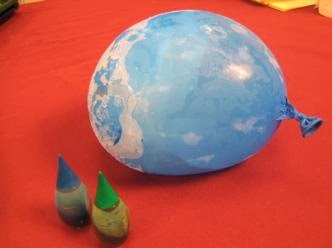
Want to explore more about ice and cold? Try out this cool experiment (not just for kids). It was one of the first ones I ever taught and study teaching but love to use it over and over. Lots of fun and easy to do! Great for all sorts of investigation and questioning experiments extensions. Plus it just looks really cool.
ICE BALLS
materials: water balloon, freezer (or very cold weather) water, food color, flashlight, pie pan, salt

Freeze water balloons a few days ahead of time. You want to fill them up to be big enough to cup in both hands or smaller. Unwrap balloon and discard, place in pan to catch drips and begin to observe in a dark room with a flash light
Each balloon is unique! 


Pour salt over ice and watch it melt you can experiment with other things like sugar and flour with out telling kids what the substances are. Add food coloring to follow the trails of melt. 

Tuesday, November 5, 2013

Science Behind... Leaves Changing Color


Talk nerdy to me...why do leaves change color? 

Dust off that Biology book to answer why leaves change color. It is the peak right now in Northeastern Ohio and the colors are just amazing.  This year with the cooler temperatures have been a great set up for a wonderful palate of fall foliage! There are a ton of foliage maps to check out. I like to look at this site that has current pictures and maps to see where is peak or just turning.

do you remember those days?
First you need to know why plants are green. I'm sure we all remember from our jello model of the plant cell back in elementary school that chloroplasts make chlorophyll and this gives leaves a green color. But why? It has do with light... the little particles called photons. The wavelengths of these photons that don't absorb we see as color. Chlorophyll absorbs violets and red wavelengths and does not absorb green hence the green leaf color. 
Ok but why do leaves change color? As you get further away from the equator the angle of the sun changes giving us the seasons. As we transition into fall there is less direct sunlight which which means less chlorophyll (and less photosynthesis reactions) is produced and the green color fades.

 Now living things are amazing and have some back up plan. There are other pigments in the leaf called carotenoids and anthocyanins that absorb a different spectrum of wavelengths. They show up as the yellows, reds, and oranges we see in the fall. These pigments are always there but get covered up until chlorophyll fades. Why the leaves fall off after this change is a whole different discussion..if you really want to know message me.
look at all the different pigment colors!
Different trees have different varieties of pigments giving us all the beautiful fall colors. Carotenoids are not light dependent and will produce yellow color, while anthocyanins need light (and with a little chemistry) give us the nice red color. Temperature affects the rate of chemical reactions so it is also a factor in leaf color. But the number one key to fall foliage is light: sunny days provide bright colors, while lots of overcast days will lead to yellows and browns.

There it is in a super simplified nutshell is why leaves change colors....while the science behind it is super cool it's best just to get out and enjoy the show nature painted this year!


Happy Adventuring!


Sunday, September 8, 2013

What I'm Reading


I have always been an avid reader,  this year I had set a goal to read 55 books. I was  on track in April completing 27. Then progress came to a screeching halt as I started summer classes. I begrudgingly gave up any free moments to read for pleasure to study bones and molecular orbitals.

After pulling an all nighter reading Finding Colin Firth  I realized reading was "the something"  missing last in the few months. You could say reading in my guilty pleasure and once I start a good book it is so hard to stop! I love nothing more to get lost in the pages of a good book. Every now an then time really flies I look up and realize it's 3 AM. oops!

I vow to keep up the pleasure reading while in class this coming semester. So I'm adding a series of what am I reading posts to the blog. Feel free to give suggestions and read along with me! Here is my past, present, and future of what I am reading. 


Finding Colin Firth 
I found myself giddy with excitement when I saw this title and that is what drew me to this book at first. I love Collin Firth movies! Plus the Cuyahoga County library suggested it as a hot new read...why would they steer me wrong? I really need to stop starting books after 9pm as I had a rough book hangover then next day, but well worth it. Good suggestion BV library!

Finding Colin Firth was a light, fun, feel good story full of hope. The story follows three women one summer in a small town in Maine, where a Colin Firth movie happens to be filming. The three women one way or another are forever entwined in each others lives. One who placed her baby up for adoption 22 years prior returns to her hometown, another recently found out she was adopted goes in search of her birth mother and the last a recently unemployed journalist is  struggling with impending motherhood. Each women finds new ways to come to terms with who they are as a person, woman, and family member. I really liked how each chapter alternated a characters view point and I quickly got engrossed with each of the women's lives. I was rooting and hoping for the best for each of them as the story progressed. 

I closed the book with a smile on my face and it was just what I needed before starting a new semester. After reading I now want to have a Colin Firth movie marathon and check out the author's previous book! There are also questions at the end of the book to assist in book club discussions. Even though this book is on the lighter side touches a lot of topics that almost anyone can relate to and would be a great choice for a book club. 


For my current read, I going a totally different directions and trying a nonfiction. As August marked Curiosity's one year anniversary I thought this book would only be fitting.


Red Rover: Inside the Story of Robotic Space Exploration, from Genesis to Mars Rover Curiosity

Wiens paints the portrait of one of the most exciting scientific stories of our time: the new era of robotic space exploration. Beginning with the Genesis mission that launched his career, Wiens describes the competitive, DIY spirit of these robotic enterprises, from conception to construction, from launch to heart-stopping crashes and smooth landings.

An inspiring account of the real-life challenges of space exploration, Red Rover vividly narrates what goes into answering the question: is there life elsewhere in the universe?
source: amazon.com


Next on the reading shelf is a historical fiction, more my normal style. I love the impressionist artists especially Degas so knew this was a book I would have to try. I picked multiple copies at the library in hopes that all the girls in the family could do a mini book club. Only my mom has read it so far, so if you want to join in I hope to have this finished by the end of October. 

The Painted Girls:  A Novel

A heartrending, gripping novel about two sisters in Belle Époque Paris. 1878 Paris. Following their father’s sudden death, the van Goethem sisters find their lives upended. Without his wages, and with the small amount their laundress mother earns disappearing into the absinthe bottle, eviction from their lodgings seems imminent. With few options for work, Marie is dispatched to the Paris, she will be trained to enter the famous ballet and is soon modeling in the studio of Edgar Degas. Her older sister, Antoinette, finds work as an extra in a stage adaptation of Émile Zola’s naturalist masterpiece L’Assommoir.

Set at a moment of profound artistic, cultural, and societal change, The Painted Girls is a tale of two remarkable sisters rendered uniquely vulnerable to the darker impulses of “civilized society.” In the end, each will come to realize that her salvation, if not survival, lies with the other. 
source: amazon.com